EMPTY CALORIES AND FAT-SOLUBLE VITAMINS MALNUTRITION: THE ROLE OF SCHOOL FACTORS IN CONTROLLING THE TREND
DOI:
https://doi.org/10.71465/hjmri.360Keywords:
Empty Calories, Fat-Soluble Vitamins, Malnutrition, School FactorsAbstract
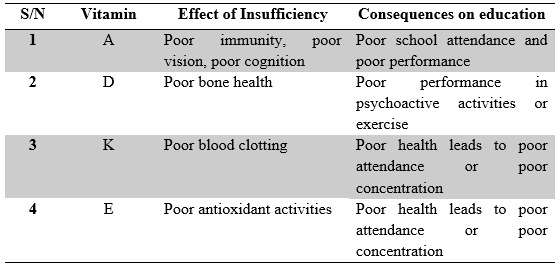
This study highlights the importance of fat-soluble vitamins (A, D, E, and K) and the risks associated with excessive consumption of empty calories (ECs). ECs, found in foods like fast food, sugary drinks, and junk food, can lead to malnutrition, obesity, and related health issues. The study emphasizes the crucial role schools play in promoting healthy eating habits and controlling ECs consumption. Schools can assess the problem, develop policies, advocate for healthy food options, and educate students and parents about nutrition. Vitamins are essential micronutrients required by the human biological system for vital body functions. They are categorized into water-soluble vitamins (B-complex and C) and fat-soluble vitamins (A, D, E, and K). Fat-soluble vitamins are stored in the liver or fatty tissues and can cause toxicity if taken excessively. Empty calories, found in foods like fast food, sugary drinks, and junk food, can lead to malnutrition, obesity, and related health issues. The consumption of empty calories can activate the brain's reward system, leading to addiction. Schools play a crucial role in promoting healthy eating habits and controlling empty calories consumption through assessment, policy development, and advocacy. The study concludes that schools can significantly contribute to reducing ECs consumption and promoting fat-soluble vitamin intake, ultimately improving students' health and well-being.
Downloads
Published
Issue
Section
License
Copyright (c) 2025 Maryam Umar Gada (Author)

This work is licensed under a Creative Commons Attribution-NonCommercial-NoDerivatives 4.0 International License.
All articles published in the Holistic Journal of Multidisciplinary Research Innovation are licensed under an open access model. Authors retain copyright of their work and grant the journal the right of first publication. The content may be freely used, distributed, and reproduced in any medium, provided the original work is properly cited and remains unaltered.


