KNOWLEDGE, ATTITUDE, AND PRACTICE OF STUDENTS OF HEALTH TECHNOLOGY SCHOOLS PERTAINING VOLUNTARY BLOOD DONATION: A SURVEY IN BAUCHI, NIGERIA
DOI:
https://doi.org/10.71465/hjmri.361Keywords:
Sokoto state, blood donation, replacement donors, paid donors, voluntary blood donationAbstract
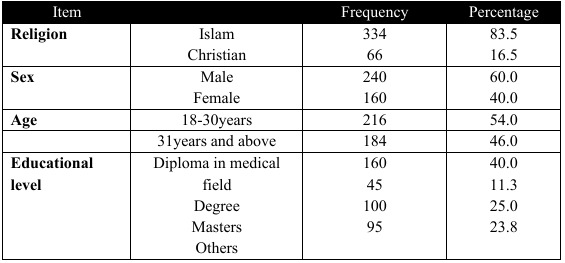
Modern days are days of increased rate of emergencies that require sufficient supply of blood. That is only properly achieved by voluntary blood donation. This study examines the characteristics, knowledge, attitudes, and practices of respondents regarding voluntary blood donation. Students are good candidates for voluntary blood donation (VBD) because they are supposedly healthy, and educated. This study applied survey descriptive study method that uses a 400 questionnaires from students of health technologies in Bauchi, Nigeria. The results were analyzed using descriptive statistics. The majority of respondents are Muslim (83.5%), male (60%), and between 18-30 years old (54%). Most respondents work in urban areas (60%) and have a Diploma in the medical field (40%). Awareness/education is the main motivator for blood donation (47.8%), while lack of awareness (60%) and fear (40%) are significant impediments. Although 64.3% of respondents are willing to donate blood voluntarily, only 41.5% have ever practiced voluntary blood donation. It is significant to intensify health education in schools and in the public arena to encourage people to donate blood voluntarily to help public health.
Downloads
Published
Issue
Section
License
Copyright (c) 2025 Yusuf Yahaya Miya, Rahmatu Jibril, Aminu Sama’ila Lassi, Anas Yusuf (Author)

This work is licensed under a Creative Commons Attribution-NonCommercial-NoDerivatives 4.0 International License.
All articles published in the Holistic Journal of Multidisciplinary Research Innovation are licensed under an open access model. Authors retain copyright of their work and grant the journal the right of first publication. The content may be freely used, distributed, and reproduced in any medium, provided the original work is properly cited and remains unaltered.


